Work order No. 006 · Woodworking Jigs & Guides
Track Saw Parallel Guide and Table Saw Dial Indicator Reviewed
One tool gives a track saw a rip fence, the other lines up a table saw blade, and each has a weak spot buyers keep pointing at.
- Where
- Workshop
- Level
- Intermediate
- Tools compared
- 2
- Brands
- GOINGMAKE
- Written by
- Ray Delgado, hand tools and woodshop jigs
- Published
- November 16, 2026
- Reading time
- 12 min
On the rule · Adjustable range, to scale in inches
2 of 2 drawn to scale from the sizes on the product pages, bars span the working range
GOINGMAKE Track Saw Parallel Guide0 to 53 in · off the scale
GOINGMAKE Table Saw Dial Indicator Gauge4 to 8.85 in
Cutting wide sheets the same width twice
A sheet of plywood too wide for the table saw ends up on the garage floor, and the track saw goes to the cut. The first cut is easy. The trouble starts when you need six strips at the same width and the rail has to be measured and marked at both ends every time.
That is the job a track saw parallel guide takes on. It clamps a second set of bars to the rail and holds it at a set distance from a reference edge, much as a rip fence does on a table saw. You set the width once, slide the stock up to a stop and cut.
The second tool here solves a different problem on the other machine. A table saw only cuts square and parallel if the blade and fence line up with the miter slot. A dial indicator gauge rides in that slot and shows how far off they are.
Both products come from GOINGMAKE, and both are cheap next to their name-brand cousins. They share a theme: each does one job well if you can read it accurately.
The guide asks you to read a scale through a magnifier. The gauge asks you to read a dial that one buyer calls flimsy. If you have ever squinted at a pencil line on a long rail, you already know why that matters.
We would pick the gauge for most home shops. We'd pick the parallel guide only if your rail is on its list, you cut a lot of sheet goods, and your eyes are good with fine print. You will see why in the sections that follow, starting with the guide.
Two tools, two different jobs
Adjustable range (inches)
Owner rating (of 5)
Owner ratings
Price
| Feature | GOINGMAKE Track Saw Parallel Guide | GOINGMAKE Table Saw Dial Indicator Gauge | Also reviewed · GOINGMAKEGoingmake Portable Drill Guide | Also reviewed · GOINGMAKEGoingmake Chisel and Plane Honing Guide |
|---|---|---|---|---|
| Price | $189.99 | $43.69 | $99.99 | $44.99 |
| Rating | 3.9 of 5 | 4.2 of 5 | 4.4 of 5 | 4.4 of 5 |
| Ratings | 178 | 75 | 51 | 383 |
| Material | Aluminum Alloy | Metal and Aluminum Alloy | Metal | Aluminum |
| Weight | 8.82 pounds | 3.41 pounds | 4.86 pounds | 2 pounds |
| Best for | repeat rip cuts on sheet goods too wide for a table saw | an occasional blade and fence alignment check on a 3/4 inch slot | angled holes and big pieces that will not fit a drill press | sharpening chisels and plane irons at a repeatable angle |
These two are not rivals. One sits on a track saw rail and the other rides in a table saw slot. You would pick between them only if you have one saw and one weekend.
The guide is the larger and heavier tool, at 8.82 pounds against 3.41 pounds for the gauge. It is hand powered like the gauge, but it needs a track saw and a compatible rail. The gauge needs a 3/4 inch slot.
On accuracy the claims point different ways. The guide's flip stop adjusts to 0.001 inch, which is about 0.025 mm, and the gauge's dial reads to 0.01 mm.
The two figures describe different parts, so they are not a contest. What matters is how easily you can read each one.
There the gauge is simpler. A dial is a dial, and no buyer of the gauge complains about reading it. On the guide, the magnifier is the sore spot in the buyer reviews.
Build feel goes the other way. Buyers praise the guide's solid aluminum and joints with no play, while the gauge's dial draws the word flimsy from a four star reviewer.
The guide asks for a larger purchase and a patient setup. The gauge asks for a few minutes and a video, and you can be done before the coffee cools.
The parallel guide that turns a rail into a rip fence
- 1Flip stop
- 2Scale
- 3Track saw guide rail
Nameplate · GOINGMAKE
| Weight | 8.82 pounds |
|---|---|
| Model | TSPG58 |
| Color | Black |
| Material | Aluminum Alloy |
| Power | hand_powered |
| In the box | 1 Set x Track Saw Guide Rail Parallel Guide |
Works with
Track saws: Festool, Makita, Milwaukee, Triton, WEN
From the GOINGMAKE product page
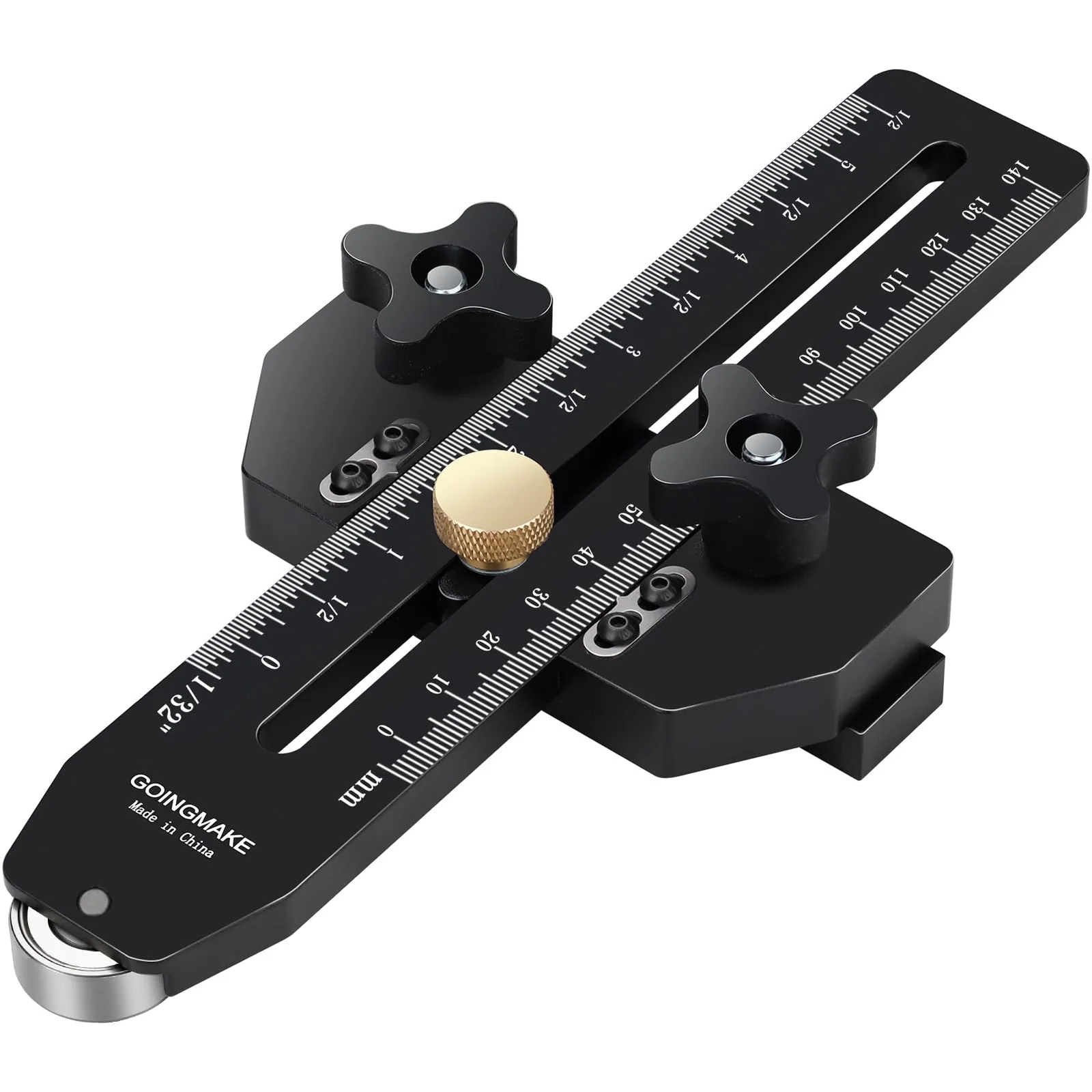
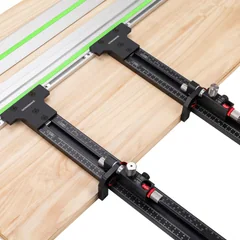
A parallel guide turns a track saw rail into something close to a rip fence. GOINGMAKE says the system holds the cutting line parallel to the stock's edge at the distance you set, so every strip comes out the same width without measuring and marking.
The kit has two connect brackets, eight T tracks, two flip stops, twelve T track connectors and two extension rods. The brand says you can use one to four tracks depending on the cut. The frame is aluminum alloy and the box weighs 8.82 pounds.
Range is the number to check first. GOINGMAKE lists standard repeatable cuts from 12 to 53 inches and narrow rips from 0 to 12 inches, with independent imperial and metric scales. The metric ranges are 300 to 1350 mm standard and 0 to 300 mm narrow.
dialing in your measurement is extremely difficult through the magnifying glass
The brand says it fits Festool, Makita, Milwaukee, Triton, Powertec and WEN guide rails. One reviewer ran it on a WEN track saw and called the setup easy. If your rail comes from another brand, check it against that list before you order.
For fine adjustment, GOINGMAKE gives the flip stop 0.001 inch (0.0254 mm) of adjustment. That is the brand's figure.
A calibration knob zeroes the scale against a square, and you need to own one, because the square is not in the box. The brand sells its own track saw square separately.
Setup takes some patience. One reviewer says the eight pieces are labeled 1-1 through 1-4 on each side, and suggests tightening half the bar into one guide before adding the second. A reviewer who got the alignment right says the guides then held their position.
What buyers like is the build. Several describe solid aluminum with no play in the joints once assembled. One reviewer found the weight of the guides helped keep the track in place without clamps, and added that the heft comes from the adjustment mechanism, so the track needs careful handling to avoid twisting.
The weight cuts the other way for another buyer. A four star reviewer says it is heavy compared to the guide they already owned, though they call it durable and like how the small cut rods lock.
The complaint that matters most is the magnifier. A two star reviewer says dialing in a measurement through the magnifying glass is extremely difficult, which hurts the one thing a parallel guide is for. Another reviewer finds the needle hard to see through the glass, and a third wants better points on the magnifiers.
One more gripe is the scale layout. A reviewer wishes imperial and metric sat on opposite sides, so the unit you use is always on the outside. As built, you read through both sets.
You should skip it if your rail comes from a brand outside the list, or if you cannot read fine scale marks comfortably. If you only rip a strip or two now and then, you will not use enough of the range to justify the setup time.
One-star and two-star scores add up to about 18 percent of ratings, and the star average is 3.9. That is the weakest score of the two products here, and the magnifier explains much of it.
Owners on the GOINGMAKE Track Saw Parallel Guide
2 out of 5 Good quality, but hard to get accurate
I’m impressed with the quality, but as other reviewers have pointed out, dialing in your measurement is extremely difficult through the magnifying glass. This effects your ability to achieve accuracy, which is a critical function of parallel guides..
5 out of 5 Wish I Bought These Sooner
I put off buying parallel guides for a long time, and I regret not doing it sooner. They’ve sped up my workflow tremendously, especially when breaking down sheet goods too wide for my table saw. Since I break down sheet goods on my garage floor, they’ve also saved my knees from crawling around from one end of the track to the other, checking and double-checking the setup. The weight of the guides even helps keep the track in place without clamps, which is a bonus I didn’t expect. - Setup & Compatibility: Easy to assemble and worked seamlessly with my WEN track saw. - Accuracy: Calibration was straightforward, and once dialed in, cuts are very precise. I still double-check measurements out of habit, but the scale has proven reliable. - Micro Adjustment: I’ve only used it to fine-tune measurements so far. The needle can be a little hard to see through the glass, but…
4 out of 5 Great tool good price!
Great tool. Easy to use. Makes easily repeatable cuts. Gave 4 stars because it is heavy compared to my other one. Super durable though. Very much like how the small cut rods lock into place. Could use better points on magnifiers. Micro adjusts are great. Super accurate. Measurements are spot on. Wish imperial and metric were on opposite sides of the sets so if you are using metric those measures are on the outside and if you swap the side then imperial is on the outside. Other than that love the system. Highly recommend.
A miter slot gauge for aligning blade and fence
- 1Dial indicator
Nameplate · GOINGMAKE
| Weight | 3.41 pounds |
|---|---|
| Model | TSDDI |
| Color | Black |
| Material | Metal and Aluminum Alloy |
| Power | hand_powered |
| In the box | 1 Set x Table Saw Gauge Dial Indicator |
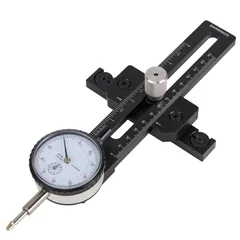
The table saw gauge has one job: tell you how far the blade or fence sits from the miter slot. It slides in the slot on a bar with two adjust rings that take up slop. You touch the dial indicator to the blade or the fence and read the difference as you slide it along.
GOINGMAKE gives the dial 0.01 mm accuracy. The brand also says the gauge fits most table saws, band saws and router tables with a 3/4 inch wide slot. A reviewer confirms it sat well in a standard 3/4 inch miter slot, T or U shaped.
Measure your slot before you order. The brand's fit statement is for 3/4 inch slots only. A saw with a different slot width needs a different tool.
The length adjusts from 4 inches to 8.85 inches, and an extra support base helps it slide steadily. That span lets one gauge reach from the slot to a blade or a fence on saws with different table layouts, though the brand does not name specific saw models.
The setup, per the brand, is short. Slide the bar into the slot, adjust the two rings until no slop remains, touch the dial to the blade or fence, then slide the gauge along and read the change. You are checking whether the number stays the same from front to back.
The material is listed as metal and aluminum alloy, and the unit weighs 3.41 pounds. Small and light, it lives in a drawer.
GOINGMAKE says the gauge helps you set the rip fence parallel to the slot and eliminate blade wobble, and calls it safer for the saw's user. Those are the brand's claims. For the saw itself, follow its manual.
Buyers who needed it for setup are mostly happy. One weekend woodworker says cut consistency improved after calibrating, especially on long rips, and that slight kickback dropped. Another calls the gauge well suited to dialing in a table saw.
The critical notes are small but specific. A four star reviewer calls the dial indicator a bit flimsy, compares it with the pricier Starrett and Mitutoyo brands, and expects it to hold up for seldom use, not daily use. They also wished the gauge mounted into the slider more quickly.
The instructions are a gap. The weekend woodworker calls them minimal and suggests a video or two for calibration. One buyer wanted a phone number to ask questions, and the weekend woodworker wished for a pouch or case so a precision tool is not rolling around in a drawer.
A shop that checks alignment every week, or needs an instrument it can trust to a tight tolerance for years, should look at a sturdier one.
For a home shop that checks the blade a few times a year, it is a fair deal. Four and five stars together cover about 83 percent of ratings, with an average of 4.2, and you can tell from the reviews that most buyers use it exactly that way: set up, check, put away.
Owners on the GOINGMAKE Table Saw Dial Indicator Gauge
4 out of 5 Works well
I found this unit well suited for dialing in my table saw. The parts are well built although the dial indicator seems a bit flimsy. But hey we're not paying Starret or Mitutoyo prices so it's about as expected, and it performed this very-seldom-needed function well. I expect the instrument might not hold up as well for daily or regular use, but for as often as you need to adjust your table saw's blade alignment it should last a lifetime. I did wish the gauge mounted into the slider more easily/quickly, but that's just a minor complaint. Overall I was satisfied with the purchase.
5 out of 5 Accurate Table Saw Gauge for DIY Projects—Small Learning Curve
As a weekend woodworker, I picked up this table saw gauge indicator to help improve my cuts—especially for getting blade and fence alignment just right. I’ve been impressed with the level of precision it adds to my setup. Once calibrated, it’s made a noticeable difference in reducing slight kickback and improving cut consistency, especially on long rips. The digital readout is clear and accurate, and the build quality feels solid for the price. The gauge fits well in the miter slot of my saw, and I appreciate the tight tolerances—no wiggle or slop. One thing to note: there’s a bit of a learning curve if you haven’t used a setup gauge like this before. The instructions are minimal, so you might want to watch a YouTube video or two for proper calibration. Also, I wish it came with a storage case or pouch—this feels like a precision tool, and I don’t want it just…
Who should buy which
We recommend the table saw dial indicator to a home woodworker who wants to check blade and fence alignment against a 3/4 inch slot a few times a year. It is light, cheap, and buyers report good results once it is calibrated. Plan on watching a video for the first use and keep it in a pouch of your own.
We do not recommend it as a daily instrument. One buyer expects the dial not to hold up under regular use, and the shop that aligns every week should buy something sturdier.
The parallel guide is a conditional pick. It suits a woodworker who breaks down sheet goods on the floor, owns a rail from the brand's list, and can read a fine scale comfortably. For that person the solid aluminum and the wide range are real gains.
We do not recommend the guide if your rail is not on the list, if your eyesight makes the magnifier a chore, or if you cut only a few strips a year. A pencil and a clamped straightedge will do for that. A two star reviewer says the scale is extremely hard to read through the magnifying glass, and that is the one job the guide has to get right.
Buy the gauge first if you can only have one. Buy the guide only after checking the rail list and your own comfort with a magnifier.
How to zero the parallel guide before the first cut
GOINGMAKE describes the setup in a few stages, and one buyer adds a practical tip. Start with the rail on a flat bench so you can see the joints close up. Have a square ready, since the kit does not include one.
After zeroing, make the first cut in scrap and measure the strip with a good rule. Compare the strip with the scale before you trust it on your good sheet.
For the table saw gauge, the brand's sequence is similar. Slide it in the slot, tighten both rings until the play is gone, then touch the dial to the blade or the fence. Check your saw's manual before you adjust anything, and keep the gauge in a pouch afterward, since the box has no case.
- Slide the connect inserts into the track saw guide rails and lock them in square.
- Connect the T track to the bracket until it touches the bracket edge, then lock the screws.
- Slide the flip stop onto the T track and connect the calibration rod to the flip stops.
- Tighten the plastic head on the rod before you tighten it to the flip stop.
- Touch the flip stop and plastic head to the edge of a square, then turn the zero calibration knob until the indicator reads 0.
- Tighten half the bar into one guide first, then add the second side, as one buyer suggests.
What buyers keep saying
GOINGMAKE Track Saw Parallel Guide
3.9 (178 ratings) 50+ bought in past monthGOINGMAKE Table Saw Dial Indicator Gauge
4.2 (75 ratings)On the parallel guide, five stars make up about 55 percent of ratings and four stars take 15 percent. The rest split between 12 percent at three stars, 5 percent at two and 13 percent at one. The shape is wide, and the low end comes from reading the scale, not from broken parts.
Praise centers on the build and the repeatable cuts. Reviewers from the United States and Australia use words like solid, well made and spot on. The recurring negatives are the magnifier, the weight and the dual scale layout.
The gauge is more consistent. Among gauge buyers, about 59 percent gave five stars, 24 percent gave four, and only 11 percent gave one or two. Buyers talk about its fit in the slot and its cheap price.
The complaints there are gentler. Reviewers mention a flimsy dial, short instructions, a learning curve and no storage pouch. A few reviews are short, a line or two about the buyer's partner liking it, and say little about the tool itself.
One review of the gauge mentions a digital readout, which does not match a dial indicator. We gave that review less weight.
The weight of the guides even helps keep the track in place without clamps
the dial indicator seems a bit flimsy
Fits for 3/4 inch wide table saw slot
Star averages, the star split and monthly “bought” counts as they stood on the product pages on November 16, 2026.
What else can do the same job
For repeat widths, the plain alternative is a tape measure, a pencil and a clamped straightedge. It costs almost nothing and needs no rail brand to match.
It is better when you cut a few strips a year, because there is nothing to calibrate. It is worse on long runs, where you recheck both ends of the rail every time.
A table saw with a good rip fence is the other alternative. It is better when the sheet is small enough to handle, since the fence locks and the stock runs against it. The reason to reach for a track saw and a parallel guide is the stock that will not fit on the saw.
A full sized dedicated panel saw or a track saw with a longer built-in fence would be better still for a shop that breaks down sheets all week. They cost far more, take floor space and need a bigger commitment than a garage hobbyist makes.
For saw alignment, the common alternative is a precision dial indicator on a magnetic base, sold by the established instrument brands. It is better for daily use and tight tolerances.
A square and a steel rule will also show gross error, but they do not show the small drift a dial catches. A gauge like this one sits between the two. It reads finer than a rule and costs a fraction of the instrument brands.
If you want a ready-made miter slot jig with a long track record, look at the established woodworking brands too. Compare their slot width and rated tolerance against the 3/4 inch slot and 0.01 mm figure here before you decide.
Questions owners ask before the job
Which track saws does the GOINGMAKE parallel guide fit?
GOINGMAKE says its parallel guide fits Festool, Makita, Milwaukee, Triton, Powertec and WEN guide rails. One reviewer used it with a WEN track saw and found setup easy. If your rail comes from another brand, check it against that list before ordering.
How wide a cut can the track saw parallel guide make?
The GOINGMAKE parallel guide covers standard repeatable cuts from 12 to 53 inches and narrow rips from 0 to 12 inches, per the brand. In metric that is 300 to 1350 mm and 0 to 300 mm. You can use one to four tracks to suit the cut size.
Is the GOINGMAKE table saw dial indicator good for beginners?
The GOINGMAKE dial indicator gauge suits a beginner who is willing to learn it, since the weekend woodworker who reviewed it calls the instructions minimal and suggests a video or two. Its 0.01 mm dial and 3/4 inch slot fit are the brand's specs. Expect a short learning curve.
Which is better for accuracy, the parallel guide or the dial indicator?
The dial indicator reads to 0.01 mm and the parallel guide's flip stop adjusts to 0.001 inch, but they measure different things. The gauge aligns a table saw. The guide sets cut width on a rail. Buyers find the dial easier to read than the guide's magnifier.
Does the table saw gauge fit every miter slot?
No. GOINGMAKE says the table saw gauge fits a 3/4 inch wide slot and works on most table saws, band saws and router tables with that size. Measure your slot first. Its length adjusts from 4 inches to 8.85 inches.
What does the track saw parallel guide not include?
The kit does not include a track saw square, and you need one to zero the calibration knob. The set holds two connect brackets, eight T tracks, two flip stops, twelve T track connectors and two extension rods. GOINGMAKE sells its own square separately.
Next on the board
More work orders for “square up a table saw for clean cuts”
-
WO 005WorkshopIntermediate
A Heavy Miter Gauge and a Thin Rip Jig for Your Saw's Miter Slot
1 WITH CAVEATS1 PASS2 tools · Ray Delgado
-
WO 007WorkshopIntermediate
Pocket Hole Jig or Doweling Jig for Hidden Joints in Wood
1 WITH CAVEATS1 PASS2 tools · Ray Delgado
-
WO 008WorkshopIntermediate
Cabinet Hinge Jig and Shelf Pin Jig Compared for Woodshops
1 PASS1 WITH CAVEATS2 tools · Ray Delgado
-
WO 009Woodshop
Goingmake Portable Drill Guide and Chisel Honing Guide Reviewed
1 WITH CAVEATS1 PASS2 tools · Ray Delgado